
Abstract–
Language is a precious gift given by God. Language is a glorious gift that differentiates human being from animals. Language makes a man, the real man. Language has multi-roles more than stream of sounds that flows from the tongue of the speaker. Language connects the world to the man. Language reflects the man.
INTRODUCTION
Language is basically a system of communication where sound or signs convey objects, actions and ideas. Language is used to inform others, to ask them to do certain things and to express feelings, moods, ideas, information, experiences etc.Being able to speak English is not just about being able to communicate with native English speakers, it is the most common second language in the world.Learning English is important as it enables you to communicate easily with your fellow global citizens. Language undoubtedly has a very important social purpose because it is mainly used for linguistic communication.The history of language dates back to many thousands of years. Learning a second or a foreign language is more than learning a description of it. It is developing the ability to use the language on habit level. This is true of not only second language learning but also of first language learning. Fundamentally, all language learning involves the process of listening, speaking, reading and writing. These process involve both linguistic and psychological aspects. This leads us to understand that all language learning is based on certain well-defined principles derived from linguistic science as well as psychological science. Knowing English increases your chances of getting a good job in a multinational company within your home country or for finding work abroad. It’s also the language of international communication, the media and the internet, so learning English is important for socializing and entertainment as well as work. A language is a structured system of communication. Language, in a broader sense, is the method of communication that involves the use of particularly human –languages.The scientific study of language is called linguistics. Questions concerning the philosophy of language, such as whether words can represent experience, have been debated at least since Gorgias and Plato in ancient Greece. Thinkers such as Rousseau have argued that language originated from emotions while others like Kant have held that it originated from rational and logical thought. 20th-century philosophers such as Wittgenstein argued that philosophy is really the study of language. Major figures in linguistics include Ferdinand de Saussure and Noam Chomsky. Language is a system that consists of the development, acquisition, maintenance and use of complex systems of communication, particularly the human ability to do so; a language is any specific example of such a system. The scientific study of language is called linguistics.

Old English (450-1.100)
The history of the English language really started with the arrival of three Germanic tribes who invaded Britain during the 5th century AD. These tribes, the Angles, the Saxons and the Jutes, crossed the North Sea from what today is Denmark and northern Germany. At that time the inhabitants of Britain spoke a Celtic language. But most of the Celtic speakers were pushed west and north by the invaders – mainly into what is now Wales, Scotland and Ireland. The Angles came from “England” [sic] and their language was called “Englisc” – from which the words “England” and “English” are derived. Their language, now known as “Old English“, was soon adopted as the common language of this relatively remote corner of Europe. Although you and I would find it hard to understand Old English, it provided a solid foundation for the language we speak today and gave us many essential words like “be”, “strong” and “water”.
Middle English (1.100 – 1.500)
The Viking invasion: With the Viking invasions (Vikings were a tribe of Nordic people that ransacked their way through Northern and Northwestern Europe 1,000-1,200 years ago), Old English got mixed up with Old Norse, the language of the Viking tribes. Old Norse ended up giving English more than 2,000 new words, including “give” and “take”, “egg”, “knife”, “husband”, “run” and “viking”.
The French are coming: Although English was spoken widely on the British Isles by 1,000 AD, the Norman invasion established French as the language of royals and of power. Old English was left to the peasants, and despite its less glamorous status, it continued to develop and grow by adopting a whole host of Latin and French words, including everyday words such as “beer”,”city”, “fruit” and “people”, as well as half of the months of the year. By adopting and adapting French words, the English language also became more sophisticated through the inclusion of concepts and words like “liberty” and “justice”.
Modern English
Early Modern English (1500 – 1800) – the tempest ends in a storm: In the 14th-15th century, following the Hundred Years War with France that ended French rule of the British Isles, English became the language of power and influence once again. It got a further boost through the development of English literature and English culture, spearheaded by William Shakespeare. Shakespeare’s influence on the development of the English language and its unique and rich culture is hard to grasp; the man is said to have invented at least 1,700 words, including “alligator”, “puppy dog”, and “fashionable”, in addition to penning classics like Romeo & Juliet and Hamlet! Towards the end of Middle English, a sudden and distinct change in pronunciation (the Great Vowel Shift) started, with vowels being pronounced shorter and shorter. From the 16th century the British had contact with many peoples from around the world. This, and the Renaissance of Classical learning, meant that many new words and phrases entered the language. The invention of printing also meant that there was now a common language in print. Books became cheaper and more people learned to read. Printing also brought standardization to English. Spelling and grammar became fixed, and the dialect of London, where most publishing houses were, became the standard. In 1604 the first English dictionary was published.
Last Modern English (1800 – Present): The main difference between Early Modern English and Late Modern English is vocabulary. Late Modern English has many more words, arising from two principal factors: firstly, the Industrial Revolution and technology created a need for new words; secondly, the English-speaking world was at the center of a lot of scientific progress, scientific advances went hand-in-hand with the evolution of the language.
English goes global
From around 1600, the English colonization of North America resulted in the creation of a distinct American variety of English. Some English pronunciations and words “froze” when they reached America. In some ways, American English is more like the English of Shakespeare than modern British English is. Some expressions that the British call “Americanisms” are in fact original British expressions that were preserved in the colonies while lost for a time in Britain (for example trash for rubbish, loan as a verb instead of lend, and fall for autumn; another example, frame-up, was re-imported into Britain through Hollywood gangster movies). Spanish also had an influence on American English (and subsequently British English), with words like canyon, ranch,stampede and vigilante being examples of Spanish words that entered English through the settlement of the American West. French words (through Louisiana) and West African words (through the slave trade) also influenced American English (and so, to an extent, British English). Today, American English is particularly influential, due to the USA’s dominance of cinema, television, popular music, trade and technology (including the Internet). But there are many other varieties of English around the world, including for example Australian English, New Zealand English, Canadian English, South African English, Indian English and Caribbean English.
English of the 21st century
And on that note: the most amazing thing about English is that it’s still evolving. From the development of local dialects and slang in countries as far apart as the US, South Africa and New Zealand, and in cities as different as New York, Oxford and Singapore, to the incorporation of tech vocabulary into everyday English. English is in a constant state of flux. Vocabulary alone is increasing at a pace of approximately 1,000 new and approved words per year; and these are just the words that are considered important enough to get added to the online version of the English Dictionary! This dramatic increase in new words is largely due to technology, and how people spontaneously coin new words in their email and text transmissions that spread quickly and efficiently via social media. A large percentage of new words are portmanteau words, also called blended words — a word that combines the meaning of two discrete words; for example, cineplex is formed from cinema and complex, bromance is formed from brother and romance, staycation is formed from stay and vacation.
LINGUISTIC PRINCIPLES
English is teaching in the schools as a compulsory subject. A good teacher is always keen to adopt the new ways of teaching English so that he/she may get satisfaction in teaching. He works on new principles and innovations for the teaching. The knowledge and application of principles help the teacher to teach effectively. According to Washington, “ Important principles may and must be flexible,” There should be linguistic principles to make the teaching fruitful. Every human knows at least one language, spoken or signed. Linguistics is the science of language, including the sounds, words, and grammar rules. Words in languages are finite, but sentences are not. It is this creative aspect of human language that sets it apart from animal languages, which are essentially responses to stimuli.The rules of a language, also called grammar, are learned as one acquires a language. These rules include phonology, the sound system, morphology, the structure of words, syntax, the combination of words into sentences, semantics, the ways in which sounds and meanings are related, and the lexicon, or mental dictionary of words. When you know a language, you know words in that language, i.e. sound units that are related to specific meanings. However, the sounds and meanings of words are arbitrary. For the most part, there is no relationship between the way a word is pronounced (or signed) and its meaning. Knowing a language encompasses this entire system, but this knowledge (called competence) is different from behavior (called performance.) You may know a language, but you may also choose to not speak it. Although you are not speaking the language, you still have the knowledge of it. However, if you don’t know a language, you cannot speak it at all. There are two types of grammars: descriptive and prescriptive. Descriptive grammars represent the unconscious knowledge of a language. English speakers, for example, know that “me likes apples” is incorrect and “I like apples” is correct, although the speaker may not be able to explain why. Descriptive grammars do not teach the rules of a language, but rather describe rules that are already known. In contrast,prescriptive grammars dictate what a speaker’s grammar should be and they include teaching grammars, which are written to help teach a foreign language. There are about 7,000 languages in the world right now (a rough estimate), and linguists have discovered that these languages are more alike than different from each other. There are universal concepts and properties that are shared by all languages, and these principles are contained in the Universal Grammar, which forms the basis of all possible human languages.
Language is a system that associates sounds (or gestures) with meanings in a way that uses words and sentences.
Linguistics is the scientific study of human language. It tries:
• first, to observe languages and to describe them accurately,
• then, to find generalizations within what has been described,
• finally, to draw conclusions about the general nature of human language.
Applied linguistics attempts to make practical use of the knowledge derived from general
linguistic research – in order, for example, to:
• improve the ways in which a student’s native language is taught
• help people learn foreign language more efficiently
• write better dictionaries
• improve therapy for people with language problems
• search the Internet more efficiently and successfully
Linguistics overlaps and (ideally) cooperates with: psychology, sociology, anthropology, philosophy, logic, mathematics, computer science, speech pathology, acoustics, music, crypt analysis, etc.
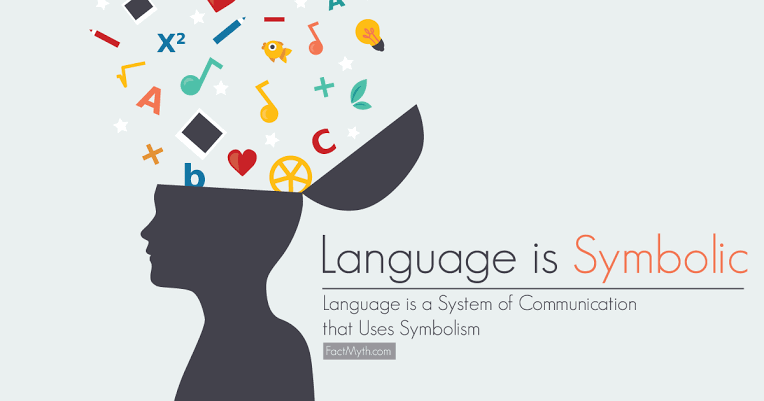
LANGUAGE IS A SYSTEM OF SYMBOLS:-
Language is a system of symbols and it works through symbols, the symbols being words. Language functions effectively when the symbols used are known to speaker and listener, the writer and the reader. The symbolic language are varied and complex. Language consists of various sound symbols and their graphological counterparts that are employed to denote some objects, occurrences or meaning. These symbols are arbitrarily chosen and conventionally accepted and employed. Words in a language are not mere signs or figures, but symbols of meaning. The intelligibility of a language depends on a correct interpretation of these symbols. Language is a system of symbols and rules that enable us to communicate (Harley, 2001). The symbols used in language can include speech sounds as well as writing; while the rules include grammar (e.g.
Pronouns, tense), parsing, pragmatics. There is an arbitrary relationship between a linguistic symbol and its referent. Language provides context for symbolic understanding. The use of language is intimately connected to cognition.
Much of the information that we gather comes from either spoken or written language. We also use language to ask questions, explain any conclusions, clarify problems, and so on. Furthermore language processing is affected by other cognitive processes such as perception, attention, and memory; and also is used in other cognitive processes such as thinking, planning, reasoning, and making decisions. Some language processing appears automatic, which is carried out without awareness or intention; while some language processing is performed intentionally and with effort. There are approximately 3000-6000 distinct languages that are spoken by humans, and approximately 250 language families, such as the Indo European language family, or the Sino-Tibetan language family. 95% of the world’s people speak fewer than 100 of the 6000 different languages, whereas the last 5% of the world’s people speak thousands discrete languages with few speakers. Mandarin alone accounts for about 1 in every 5 people on earth. If we add English, Hindi, Spanish and Russian the figure jumps to 45%. Some of these languages are disappearing due to various reasons such as hostility and repression from dominant governments, and high speed transportation and communication. Every language has its own way of encoding and expressing human experience, and an entire way of thinking
is lost each time a language becomes extinct. It is important to differentiate between language and communication. Communication is a process whereby there is exchange of information between the sender and the receiver. This information can be transmitted via any of the methods such as a scent, song, gestures, tone, writing, painting, or language. Language is a symbolic form of communication. Although there are other communication systems, but these do not form the true languages.
LANGUAGE IS ARBITRARY:-
Language is arbitrary in the sense that there is no inherent relation between the words of a language and their meanings or the ideas conveyed by them. There is no reason why a female adult human being be called a woman in English, aurat in Urdu, Zen in Persian and Femine in French. The choice of a word selected to mean a particular thing or idea is purely arbitrary but once a word is selected for a particular referent, it comes to stay as such. It may be noted that had language not been arbitrary, there would have been only one language in the world. The generally accepted view of those who study language professionally is that language is an arbitrary, cultural construct; language, on this view, is learnt by listening to speakers of the language of the particular community into which an infant is born; the words used in the language as well as the particular grammar or syntax of the language have developed historically as a social product and been handed down by tradition. At first sight, it might seem a highly academic question whether or not language is arbitrary, of interest only to linguisticians, etymologists and so on. But to say that language is arbitrary and a purely cultural product is to assert that there is no basis for relating language to other aspects of human biology, to evolution as shown in the development of brain structure and the physiological differences between men and animals. It would be a strange result if the manifestation of the major and many would say absolutely crucial human ability, the ability to speak and understand language, should on this view turn out to be something which cannot be explained and for which, in principle, no explanation can even be attempted. Arbitrary’ means chance, unmotivated, without purpose – and those who view languages as wholly arbitrary structures are saying that they are the product of chance, guided by no objective, that the availability of words and the structures of any language are completely purposeless. Yet at the same time all would recognize that language is the fundamental instrument for human communities, the essential medium of communication, the precise and powerful tool of thought, the basis for scientific and technological progress. If such a miraculous instrument is arbitrary in origin, function and structure, then one can only fall back on a belief in myth to explain it. The ancient Egyptians believed that the word was given to mankind by the god Ptah. They at least recognized the real problem, that language must have had some origin.
LANGUAGE IS PRIMARILY VOCAL:-
Language is primarily made up of vocal sounds only produced by a physiological articulatory mechanism in the human body. In the beginning, it appeared as vocal sounds only. Writing came much later, as an intelligent attempt to represent vocal sounds. Writing is only the graphic representation of the sounds of the language. So the linguists say that speech is primary. Speech is the primary concern of language, and the written form is merely a graphic representation of the oral language. Therefore, it is assumed that speech is prior in language teaching.

LANGUAGE IS FOR SOCIAL COMMUNICATION:-
Language is a set of conventional communicative signals used by humans for communication in a community. Language in this sense is a possession of a social group, comprising an indispensable set of rules which permits its members to relate to each other, to interact with each other, to co-operate with each other; it is a social institution. Language exists in society; it is a means of nourishing and developing culture and establishing human relations. Social communication is the use of language in social contexts. It encompasses social interaction, social cognition, pragmatics, and language processing. Social communication (pragmatics) is important in order to be able to build social relationships with other people. It is also important academically, as many curriculum based activities rely on working in groups and communication between peers.
LANGUAGE IS PRODUCTIVE AND CREATIVE:-
Language has creativity and productivity. The structural elements of human language can be combined to produce new utterances, which neither the speaker nor his hearers may ever have made or heard before any, listener, yet which both sides understand without difficulty. Language changes according to the needs of society. Language has creativity and productivity. The structural elements of human language can be combined to produce new utterances, which neither the speaker nor his hearers may ever have made or heard before any, listener, yet which both sides understand without difficulty. Language changes according to the needs of society. Finally, language has other characteristics such as Duality referring to the two systems of sound and meaning. Displacement which means the ability to talk across time and space, Humanness which means that animals cannot acquire it, Universality which refers to the equilibrium across humanity on linguistic grounds, Competence and Performance which means that language is innate and produced is society and furthermore, language is culturally transmitted. It is learnt by an individual from his elders, and is transmitted from one generation to another. Thus using J. Firth’s term, language is a ‘poly systematic’. It is also open to be studied from multifaceted angles
PSYCHO-LINGUISTIC PRINCIPLES
Principle of Naturalness :- When a child is born, mother is considered his first teacher. A mother is equal to hundred teachers. Teaching must be in natural way. Teaching should be based one or two basic skills, Listening and speaking. Then come to another two skills, reading and writing that come automatically to the students. Speaking will lead to writing and listening and reading. A child learns to speak in a natural atmosphere as he learns the mother tongue only by listening. He does not have to make extra effort in that. Jespersen suggests, “ The very first lesson in a foreign language ought to be devoted to initiating the pupil into the world of the sounds.”
Principle of Learning by Doing :-Language focused to develop four skills-listening, speaking, reading and writing. A child learns effectively by doing. He learns the language by model reading, imitation reading, silent reading, writing dictations and spellings which is essential.
Principle of Purpose :- Everything in the world has its purpose. So, English is also learnt for the purposes like social, scientific, academic and literary. A good teacher tells the students how effectively we can use English language in personal and professional life
both. If there is no purpose of anything, it can’t be effective and fruitful both to the teacher and learner.
Principle of Imitation :- Language is learnt at its best through imitation. When a child learns the mother tongue, it comes naturally but a foreign language needs some artificial process that is called, imitation. According to Robert Paul,” when we learn first language, we face the universe directly and learn to clothe it with speech, when we learn a sound language; we tend to filter the universe through the language already known.” Small children mostly use imitation. A good speech is the result of imitation of good models of speech. A teacher uses Audio- Video Aids to provide good model of reading, Writing,
pronunciation etc.
Principle of Habit formation :– As one’s habits need practice e.g. singing, dancing as well as language also need practice. Habit brings things fairly
automatically. The habits lie in one’s personality deeply and reflect through speech behavior and thinking. Similarly Language is an instrument of all the subjects that should automatically. According to Palmer, “ Language Learning is essentially a habit
forming process during which we acquire new habits.” The habits may be of spelling, intonation, proper accent, listening sounds, reading aloud with articulation, appropriate speed, silent reading, using words properly, learning correct structures and good
hand writing.
Principle of Motivation and Interest :- Everything is learnt when we have proper motivation to take interest in that. Similarly, a teacher must motivate the students to take interest in learning. The students can’t make a will to learn a foreign language if they are not interested in that because of boring and dull matter. Interest is created by awareness on previous knowledge, variation in teaching lesson, questioning, using teaching aids and device, experienced and activity centered teaching, debates and discussions, deductive and inductive methods, reacting immediately on wrong or right. So
many students find and accept learning English language because of lack of interest.
Principle of Practice: -“ Practice makes a man perfect.” And the perfection in the language comes only by the practice. The development of expression grammar, vocabulary, pronunciation is based on practice which should be continuous. Grammar needs a lot of practice to know the rules deeply and in direct proportion. Fries, recommended that eighty four percents of time be devoted to practice and only fifteen percent to explanation and commentary. According to Otto Jaspers, “He who gets the tip of his finger dipped in the water three times in 20 weeks will never learn how to swim.” There are different types of drill like imitation, Role playing, oral, substitution, conversation etc.
Principle of Selection:– The language should be selected according to its frequency, teaching ability, usefulness etc. Selection may be done in keeping the
view of grammar. A Person is well-learned who has learnt the vocabulary and the sentence pattern basically. There must be frequency i.e. how many times a particular language item is used at a certain stage. There must be applicability i.e. in how many
contexts it is applicable. There must be coverage i.e. how many meanings of word are carrying. There must be availability i.e. the real objects, which are used to teach, are available in the classroom or not. There must be teach-ability i.e. what items are easy to
teach and last there must be learn-ability i.e. whether it is easy for a student to learn or not.
Principle of Gradation:- Language is an art and a science both. Language teacher should proceed from know to unknown, concrete to abstract. There must be
gradation in the field of aims and objects. It means a teacher should select the base step which will be beneficial for the further study of a language . There will be grades like A,B, C, D, E to sounds, words, phrases, sentences and context respectively . First a teacher should introduce the students of the sounds like Pet, Cat, etc. Then she should tell them about words used in the same situation like college, colleagues, etc. These all should come in a group. In Sentence pattern that is made up of words should be
like that. This is my book, that is my book, This is your book, this is Radha’s book etc. Then comes to words which have similar meaning like meals (stands for dinner, breakfast etc.) house, home, shelter etc. Then there’s structure. It means –sounds make words, words into phrases, phrases into Sentences, Sentences into context.
Principle of Connection of Life:- A Language teacher should motivate the students to use the words, structures, phrases of English in their day-to-day life.
The pupils will be taught to convert their feelings, emotions, experiences, visits with their mates, close friends, teachers in English language. A teacher should create a situation regarding their real life and motivate the students to express in English language, their personal life’s situations.
Principle of Proportion:– There must be accurate proportion in all the aspects and skills of teaching . One aspect should not be sacrificed for the other. Language should be taught as a whole, According to Dr. West, “ The proportion between the passive an active aspects of learning a foreign language should be 5:2 at the early stage and later on this ratio may be 5:3.
Principle of Language aptitude:- There should be taught language aptitude i.e phonetic, coding grammar, Rote memorization, Linguistic rules and patterns. According to Carroll and spoon, “ For learning a language, language aptitude is needed.”
Principle of oral-approach :- Speaking a language always leads to reading and writing. First child learns speaking after listening the language. Then he goes to reading and writing it. It is real and vital that makes learning easy. Teacher provides the situations to the students where he talks or speaks rather than listens only. Oral-approach makes the learner active, attentive and confident among the students. If he is speaking accurately then he will read and write proper otherwise not. Oral approach also enables the students to express ides, feelings and experiences to others.
Oral-approach helps the learner to learn correct pronunciation, intonation, stress automatically while using a foreign language
Principle of Accuracy :- If someone is habitual of the wrong habits, it becomes difficult to give up all at early. Wrong habits to pronounce, Spell and write becomes difficult to get rid of. Language habit should be accurate to learn a foreign language quickly. One must try to imitate the best forms of structures.
Principle of Pupil’s Activity :-A learner should remain active not passive. The students be active in such methods like Role playing, practice and drill, drawing on the chalk board, hear and see the audio- visual aids and react to it, recitation the poems with proper using of objects from the class rooms.
Principle of Balanced Approach :- There must be balance between all the language aspects. If a teacher is giving information about prose, she must take grammar aspects side by side. If she is teaching poetry, She must inform the students about similes,
metaphors, other grammatical aspects also. If she is discussing something on written composition, she must give importance to oral composition also. There should be proper coordination in teaching a foreign language. There must be proper balance between the
language aspects while teaching English.
Principle of Maxims of teaching:- According to Oxford dictionary,” Maxims are general truths drawn from science of experience.” Maxims are the various rules for conducting the teaching. The maxims are universal and trust-worthy. The maxims are :
from known to unknown, from simple to complex, concrete to abstract means visualized to imaginative things, from induction to deduction means a conclusion from examples and vice-versa respectively, from psychological to logical means interest, age, capability to logical arrangements, from actual to representation means models to reality, from whole to part, from near to far means belong to a child then far from immediate environment, from definite to indefinite, from analysis to synthesis means divide the topic into subtopics then divide parts into the whole respectively, from empirical to rational means first direct truths and empirical principles then the logical or reasoning.
CONCLUSION
We can say that language teacher must keep the principles in her mind while teaching English language to the students. The maxims are the best tools that show the best results in teaching learning of a language. So, we can say that “Language is a means of communicating thoughts. “ A society is not existed without the language. Language expresses our feelings, thoughts, reactions etc. It brings the world together as a whole. It unites the people of the world and develops Science, Technology etc. Language helps in the instructions of any system. Education in schools and colleges among student is imparted by the language. Language motivates to raise voice against injustice, slavery etc. It may also give aesthetic pleasure to speaker, writer, reader and listener. As the most spoken language in the world, English holds a huge part in the communication. International business goes well because of English. It helps people when they are using technology products although growth of technology increasing continuously. English also helps student to understand the subject that written in English properly. Besides that, it makes the people keep in touch although they have different language and come from different country. Although human beings have for millennia taken an intense interest in the languages they speak, modern linguistics has gradually developed as an independent discipline (some would be willing to call it a science) only during the past few centuries. Hundreds of major figures have contributed to this development, and thousands of others have had a significant impact upon linguistics and its host of sub fields. It has been possible here only to introduce briefly some of the main ideas of several of the individuals who have been instrumental in making language study what it is at the beginning of the twenty-first century. In many cases, it has been possible to do little more than mention some of their names and their areas of expertise to signal to the interested reader the necessity of investigating further the full range of their work. Scores of other truly outstanding linguists have not even been mentioned at all. Traditionally, linguists and philosophers have seen the primary purpose of language as being representation and communication. Language is what enables people to articulate things, ideas and attitudes in an intelligible form and to transmit the results to other people. More recently, linguists have recognized the importance of language in identities. Language enables us to express who we think we are and how we are connected with other people.
 Edu
Edu 